
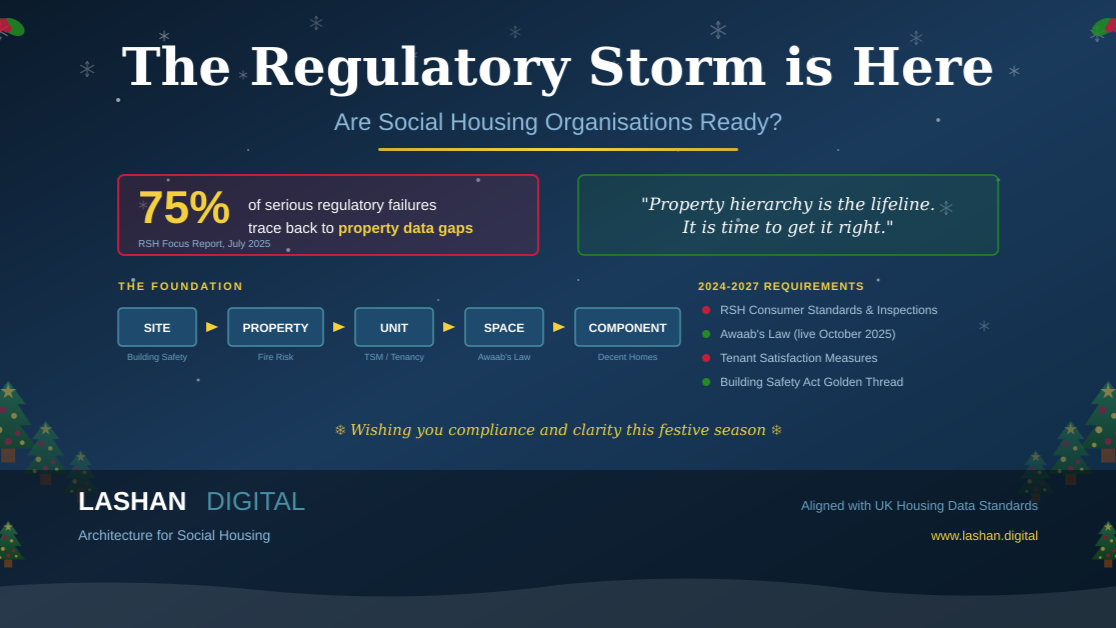
75% of Failures Share the Same Root Cause
Property hierarchy is the lifeline. It is time to get it right.
The infographic provides a reference model showing how regulatory and operational data attachment points map to each level of the property hierarchy—from Building Safety Act requirements at Site level, through TSM reporting at Unit level, to Awaab’s Law compliance at Space level. It is designed as a starting point for organisations assessing their current data architecture against sector standards.
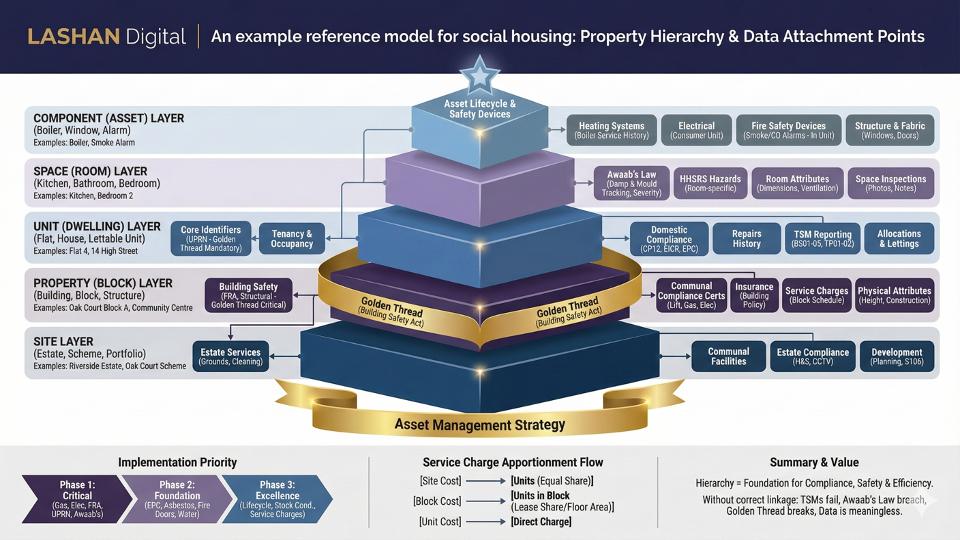
The Property Hierarchy: Foundation of Everything
The property hierarchy—Site, Property, Unit, Space, Component—is the canonical structure that ties every operational system together. Without it, organisations cannot reliably link a gas certificate to the correct dwelling, trace a damp complaint to a specific room (which Awaab’s Law requires), report how many homes are at risk from an overdue Fire Risk Assessment, demonstrate Decent Homes compliance at component level, or plan major works investment with confidence.
Research from MHCLG estimates that £400 million is wasted annually on repairs and allocations not delivered correctly—often because operatives arrive without accurate property information. Industry research suggests poor data quality can cost organisations up to 6% of annual revenues.
A Sector-Wide Framework Exists
Organisations can adopt the sector-wide frameworks such as HACT to answer the regulator’s questions with confidence. This establishes consistent definitions, stable identifiers, and clear relationships between hierarchy levels—enabling interoperability across housing management, asset management, compliance, and contractor systems.
Many organisations are rising to meet these challenges—investing in stock condition surveys, improving data systems, and engaging proactively with the Regulator. Those that do not adopt will continue to struggle with fragmented data, manual reconciliation, and the risk of public regulatory failure.
For support in implementing property hierarchy standards aligned with industry and current regulatory requirements, contact LASHAN Digital – info@lashan.digital