
When Process and Architecture Drift Apart?
Most transformations start strong. SIPOC (or equivalent methods) helps teams articulate how work actually flows, often for the first time. It brings clarity, aligns stakeholders, and paints a picture of the future. But there’s a recurring question that appears across almost every programme:
If we understand our processes so well at the start, why do so many digital transformations still miss the mark?
More often than not, the issue isn’t the technology—it’s the connection between the business view and the architectural view. SIPOC explains what the business needs to happen, but it doesn’t define how technology must support it. It was never designed to describe data structures, integrations, security boundaries, or performance requirements.
That becomes a problem when organisations assume it does.
Where Transformations Begin to Break Down?
This disconnect typically appears in two ways.
In some organisations, teams complete their SIPOC work and jump straight into selecting technology. Architecture is left to vendors or handled reactively once build begins. In others, architects do create detailed technical designs—but separately from the process view. The business artefacts sit in one folder, the architecture artefacts in another, and the bridge between them is left to interpretation.
Only when implementation begins do the gaps become visible: data models that don’t reflect the intended workflow, integrations triggered at the wrong step, security rules blocking legitimate actions. These aren’t coding defects—they’re misalignments of understanding. And fixing them late is where transformation programmes lose time, money, and momentum.
Why Late Discovery Is So Costly?
Anyone who has delivered complex programmes knows this: the later you discover a gap, the more expensive it becomes to fix.
When misalignment is found during implementation, teams must rework architecture, change processes, renegotiate vendor assumptions, or rebuild components entirely. The disruption isn’t just technical—it affects timelines, budgets, scope, and stakeholder confidence.
All because the bridge between process understanding and technical design wasn’t explicit from the start.
Building the Bridge: A Better Way Forward
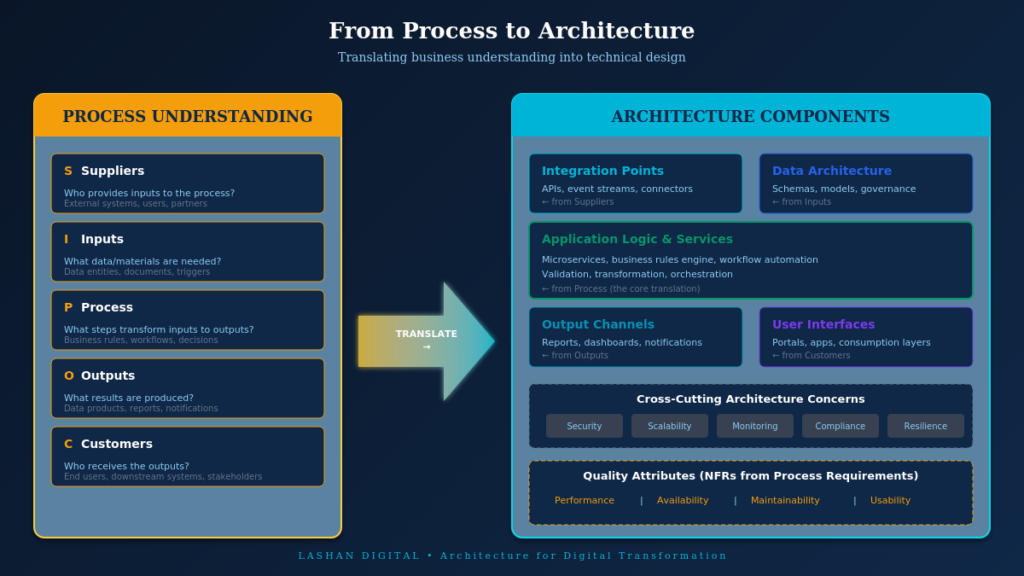
The answer isn’t heavier governance or more documentation. It’s creating a deliberate, lightweight bridge between process mapping and architectural thinking. This starts by using SIPOC—not as a workshop artefact that gets filed away—but as the organising spine for architecture.
Each element becomes a prompt:
- Suppliers → trust, authentication, availability
- Inputs → data structures, validation, triggers
- Process → performance, ownership, failure handling
- Outputs → formats, contracts, retention
- Customers → access, channels, experience
This approach transforms SIPOC from a discovery tool into a guiding framework for design. Every architectural decision becomes traceable back to business intent. When a process changes, you instantly see what technical components must adjust. It’s simple, structured, and powerful—especially for organisations without large enterprise architecture functions.
Why This Matters Even More in Resource-Constrained Sectors?
In social housing, retail, and other resource-pressed sectors, transformation risk is amplified. Programmes run with tight budgets, lean teams, and strict regulatory constraints. These organisations cannot afford late-stage surprises.
A deliberate SIPOC-to-architecture bridge provides the clarity, consistency, and assurance needed without adding unnecessary bureaucracy.
A Final Question for Transformation Leaders
Before your next programme moves from process workshops to solution design, ask yourself:
At what point do our SIPOC discussions end—and where does our architecture work begin? Is that connection explicit, or is it assumed?
If it’s assumed, that’s where your risk lives.
How We Help?
At Lashan Digital , we work with organisations to build this bridge in a practical, lightweight way tailored to their culture and constraints. If this challenge feels familiar, I’d be happy to share how we approach it. Reach out to us – info@lashan.digital
#LashanDigital #DigitalTransformation #EnterpriseArchitecture #BusinessArchitecture #SIPOC #ProcessMapping #SolutionDesign #TechLeadership