Originally published in Housing Technology magazine (Issue 111), this article was written by Viswa Gogineni, Senior Enterprise Architect and Founder of LASHAN Digital, for the magazine’s special edition on Data Management in Housing.
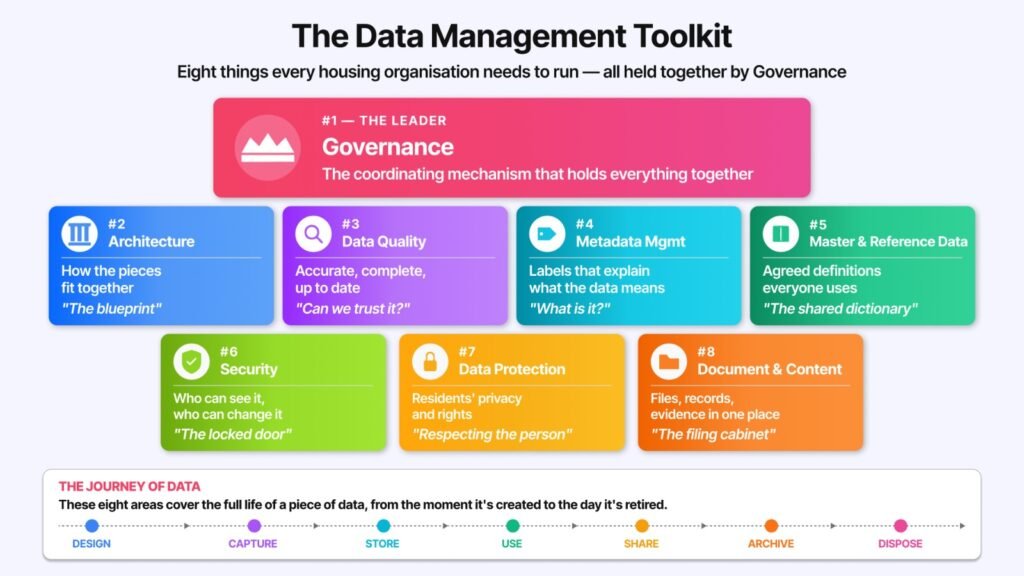
Data management is the discipline of governing, organising and maintaining the information that determines how well a housing provider understands its homes, its residents and its risks. It spans governance, architecture, data quality, metadata management, master and reference data, security, data protection and document/content management across the full lifecycle from design through to disposal.
Like financial management or health and safety compliance, data management carries permanent organisational accountability. That accountability sits with the senior leadership, not with the teams that manage the day-to-day data activities.
The accountability gap
Within most housing providers, data accountability is established at a departmental level. Each function manages its domain against its own definitions and priorities. The discipline that sits above that, covering shared definitions, cross-functional accountability and an enterprise-wide view of what the data means, is where the accountability gap can usually be found.
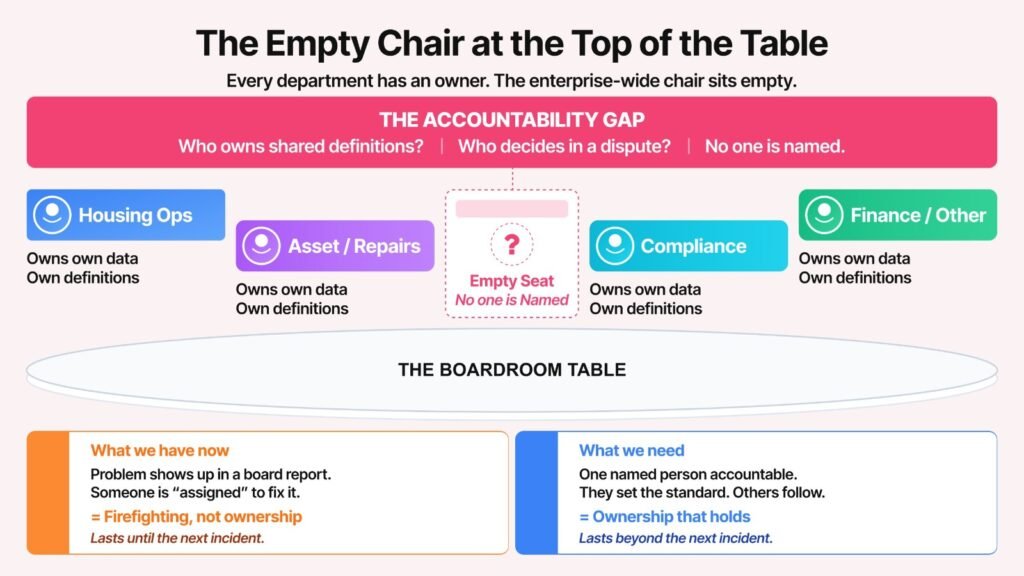
Ownership, as most organisations practise it, is reactive. A data-quality problem surfaces in a board report, a KPI return or an annual submission and someone is assigned to fix it. However, that’s incident management, not ownership.
Defined ownership means named accountability for a data domain on a continuing basis: who sets the standard, who monitors it and who makes the decision when definitions are in dispute. Without that specificity, ownership remains informal. Closing that gap therefore requires a decision by leadership to establish it.
Two layers, one discipline
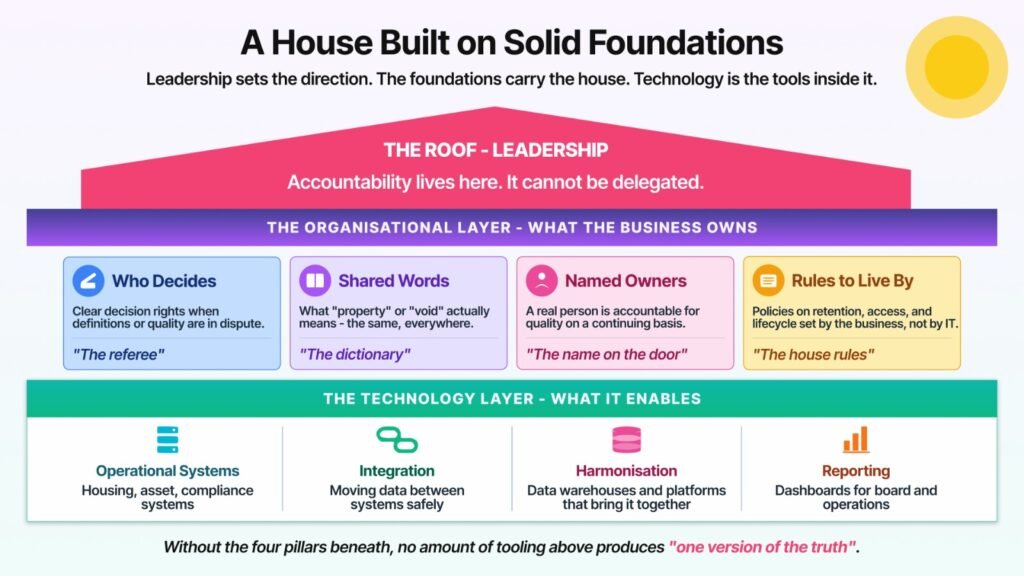
Data management has two distinct layers: the organisational layer and the technology layer. The organisational layer is what leadership owns and can’t delegate to IT. It covers governance and decision rights, agreed definitions of core terms, named quality ownership for each data domain and policies on retention, access and lifecycle.
The technology layer is what IT enables once the organisational layer is in place: the systems, integrations and platforms that store, move and surface data for decision-making.
Technology investment in the housing sector consistently moves ahead of the organisational foundations it depends on. A data platform, reporting solution or data warehouse can all be sound investments, albeit each arriving with its own data model, field names and classifications. However, without an organisational layer above them, there is no single version of the truth.
In many organisations, IT attempts to fill that gap, taking on ‘definitional’ work that belongs at the business level. IT faces a structural boundary: those decisions require business authority it doesn’t hold. The work produces artefacts rather than outcomes, so the accountability gap persists.
How to get started
Housing providers that make lasting progress don’t wait for a big-bang programme. Three approaches are worth covering below.
The first is to target a single high-risk operational process from end-to-end. Choose a process where poor data creates real and immediate risk, such as damp and mould case management, building-safety records for a priority block or complaint handling for a defined resident group. Nominate one business owner, agree shared definitions and put visible quality measures in place (a small cross-functional team can do this within weeks). The result is a working example that the organisation can build on.
The second is to anchor the data foundations to an existing investment. If the organisation is already investing in a new housing management system, a compliance programme or a platform build, this is the moment to embed the organisational layer that the technology will depend on. Keep the effort time-boxed and aligned to the organisation’s existing planning cycle, focused on shared definitions, quality ownership for the critical data domains and a focused governance mechanism where named data owners meet regularly to interrogate conflicting data. Without that, a well-implemented system inherits the same inconsistencies, merely running on newer technology.
The third is to embed the discipline into existing boards and governance rhythms. The instinct is to create a new data steering-group. Research on governance failures is consistent: committees that sit separately from operational decision-making, without authority to compel action or resolve conflict, produce ‘governance theatre’. The more durable approach is to bring data into the forums where strategic decisions are already being made. Add data quality and data risk to existing board reports alongside finance and health and safety. Ask each executive director to sponsor one or two data domains as part of their role, and then the existing decision-making rhythm becomes the operating mechanism.
When data really matters
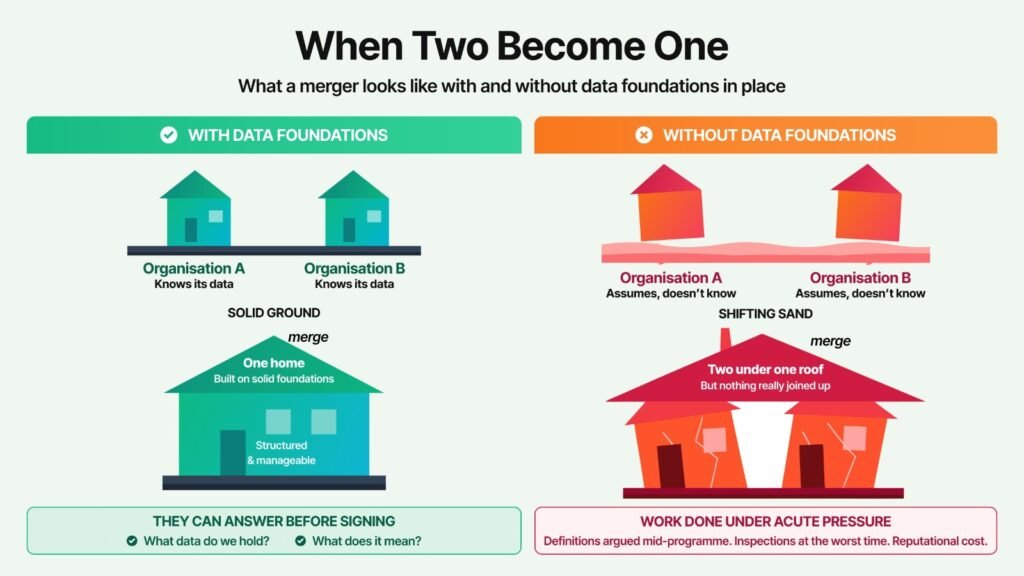
Housing organisations will face moments that demand precise, defensible answers about their data, such as a merger, regulatory inspection or building-safety programme. Whether those moments are managed processes or expensive crises depends entirely on whether the foundations were already in place.
A merger is the most immediate example. Two organisations combine, each with its own systems, field names, definitions and assumptions about what its data means. Without an organisational data-layer on either side, the merger doesn’t create a unified organisation, it just creates two ungoverned data estates under one roof.
In our experience, the organisations that navigate these moments well can answer two questions before the pressure arrives: what data do we hold and what does it mean? In instances where that work has already been done, the programme is difficult but tractable. Where it hasn’t, the organisation finds itself performing foundational work while under acute time and reputational pressures.
Good data management, established as a discipline in advance, is a material programme risk-factor and one that leadership can have full control over.
What you should be asking
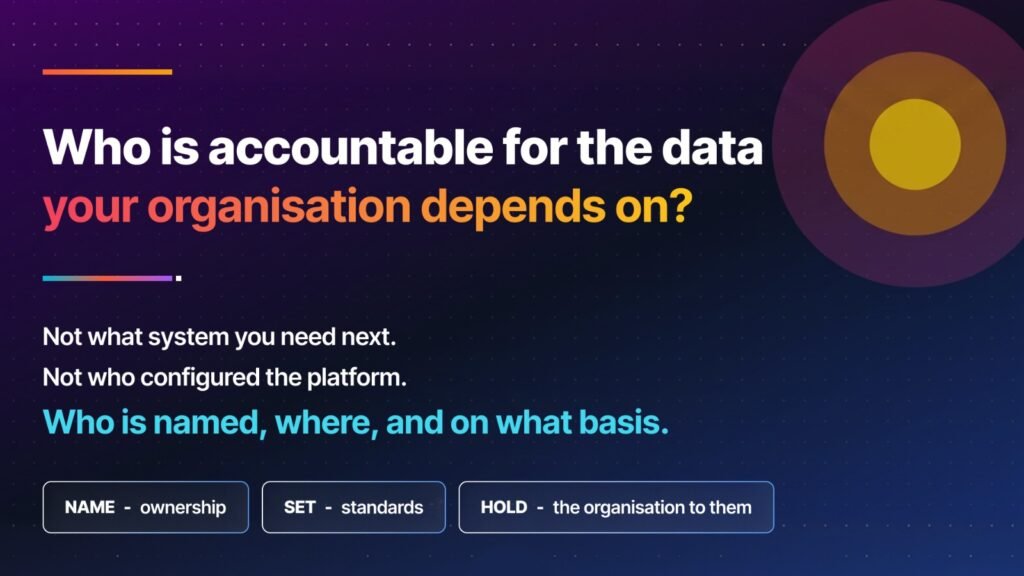
The question for every housing leader isn’t what system they need next. The question is who is accountable for the data their organisation depends on and whether that accountability sits at the organisational level. Data management at its core is a leadership decision: to name ownership, to set standards and to hold the organisation to them.
The three approaches set out above shouldn’t require extra capital expenditure or additional staff resources. They require a decision to treat data management as a permanent discipline, and that decision belongs to leadership.
These are not gaps a new system will close; they are gaps that only leadership can close.
Written by Viswa Gogineni, Senior Enterprise Architect & Founder, Lashan Digital for Issue 111 of Housing Technology Magazine.
FAQ
Frequently Asked Questions
Data consultancy for social housing focuses on improving data accuracy, governance, and confidence. It helps housing associations strengthen reporting, support compliance, reduce risk, and make better operational and strategic decisions based on trusted information.
Digital transformation in social housing goes beyond replacing systems. It involves improving data quality, integrating platforms, modernising infrastructure, and enabling teams to deliver better tenant services while meeting regulatory and security requirements.
Security and compliance are built into every solution we deliver. We align with GDPR and recognised security best practices, ensuring sensitive tenant and organisational data is protected while supporting auditability and regulatory scrutiny.
We help social housing organisations design digital and data processes that meet the time-critical requirements of Awaab’s Law, including clear workflows, inspection visibility, and reliable tracking of actions and outcomes.
Yes. Our approach is designed to work with existing housing management, finance, and asset registers/systems. We focus on secure integration, phased improvement, and minimising disruption rather than forcing wholesale system replacement.